HEPA Filters, EPA and ULPA to EN 1822
HEPA filters (High Efficiency Particulate Air filters) are particulate air filters that remove at least 99.95 percent of all particles at the most penetrating particle size (MPPS, typically 0.1 to 0.3 micrometres) from an airflow and are classified into classes H13 and H14 in accordance with EN 1822 and ISO 29463. Filters with a lower filtration efficiency are called EPA filters (E10 to E12), filters with a higher efficiency ULPA filters (U15 to U17).
HS-Luftfilterbau GmbH has been manufacturing particulate air filters in Kiel, Germany, for more than 50 years. They capture viruses, bacteria, germs, toxic dusts, radioactive aerosols, fine dust and submicron pollutants. From class H13 upwards, every filter is tested individually to EN 1822. For H13 and H14 you can order the scan test with an individual test report, from U15 it is mandatory.
Already know the design and class you need? Filter HEPA filters in the product finder



What Is a HEPA Filter?
HEPA stands for High Efficiency Particulate Air filter. HEPA denotes a performance class according to EN 1822. The standard distinguishes three groups:
- EPA (Efficient Particulate Air filter), classes E10 to E12, filtration efficiency 85 to 99.5 percent
- HEPA (High Efficiency Particulate Air filter), classes H13 and H14, efficiency 99.95 percent (H13) or 99.995 percent (H14) at the MPPS, verified by individual testing
- ULPA (Ultra Low Penetration Air filter), classes U15 to U17, efficiency 99.9995 to 99.999995 percent
How a HEPA Filter Captures Particles
A HEPA filter with glass fibre media retains particles through four physical effects acting simultaneously. The filter medium consists of a dense web of randomly arranged glass fibres with a fibre diameter below one micrometre:
- Sieving effect: particles larger than the gap between two fibres cannot pass through
- Inertial impaction: heavy particles cannot follow the airflow around the fibre and impact on it
- Interception: particles that follow the airflow touch the fibre and adhere to it
- Diffusion: very small particles move randomly across the airflow due to Brownian motion and hit fibres in the process
Inertial impaction and interception are strong for large particles, diffusion for very small ones. In between lies the performance minimum: the MPPS.
In addition to glass fibre media, we use ePTFE membranes. They are not fibre-based and separate particles mainly through sieving.
What Does MPPS Mean?
MPPS stands for Most Penetrating Particle Size, the particle size that fibre-based filters capture least effectively. Depending on the filter configuration, it typically lies between 0.1 and 0.3 micrometres. EN 1822 classifies HEPA filters specifically at this weakest point.
For your design, this means a built-in safety margin: all particles larger or smaller than the MPPS are captured with a higher efficiency than the class value. An H14 filter with 99.995 percent at the MPPS therefore retains fine dust, pollen or droplet aerosols even more reliably.
Filter Classes According to EN 1822 and ISO 29463
HEPA filters are classified according to the European standard EN 1822 and the largely identical international standard ISO 29463. Two values are decisive: the integral efficiency over the entire filter area and the local efficiency at the weakest measured point. Both limits must be met for a filter to carry the respective class.
| Group | Class | Integral efficiency (MPPS) | Local efficiency (MPPS) | Designation |
|---|---|---|---|---|
| EPA (Efficient Particulate Air) |
E10 | ≥ 85 % | no requirement | High-efficiency filter |
| E11 | ≥ 95 % | no requirement | High-efficiency filter | |
| E12 | ≥ 99.5 % | no requirement | High-efficiency filter | |
| HEPA (High Efficiency Particulate Air) |
H13 | ≥ 99.95 % | ≥ 99.75 % | HEPA filter |
| H14 | ≥ 99.995 % | ≥ 99.975 % | HEPA filter | |
| ULPA (Ultra Low Penetration Air) |
U15 | ≥ 99.9995 % | ≥ 99.9975 % | ULPA filter |
| U16 | ≥ 99.99995 % | ≥ 99.99975 % | ULPA filter | |
| U17 | ≥ 99.999995 % | ≥ 99.9999 % | ULPA filter |
Further information on classification is available at www.ISO29463.de and www.ISO16890.de.
Difference Between EPA, HEPA and ULPA
The three groups differ in the required efficiency and in the test method.
| Criterion | EPA (E10 to E12) | HEPA (H13 to H14) | ULPA (U15 to U17) |
|---|---|---|---|
| Efficiency at the MPPS | 85 to 99.5 % | 99.95 to 99.995 % | 99.9995 to 99.999995 % |
| Local efficiency required | no | yes | yes |
| Testing | Type testing | Individual testing of each filter to EN 1822-4 Annex A, scan test optional, strongly recommended for cleanroom applications | Scan test of each filter to EN 1822-4, mandatory |
| Typical use | Extraction systems, high-efficiency pre-filtration, gas turbines | Cleanroom, pharmaceuticals, medicine, laboratories, nuclear technology | Semiconductor manufacturing, cleanroom classes ISO 1 to 3 |
Use EPA filters for applications whose requirements exceed the fine dust classes of ISO 16890, for example in extraction systems, high-efficiency pre-filtration or gas turbines. Use HEPA filters as soon as the effectiveness of each individual filter element has to be documented. ULPA filters pay off where the residual particle count in the cleanroom directly determines your yield.
Type Testing or Individual Testing
EPA filters (E10 to E12) are usually classified by type testing. The efficiency is the mean value of samples taken from a series.
HEPA and ULPA filters (H13 to U17) require individual testing, in which each filter element is tested for integral and local efficiency and for leak tightness. For H13 and H14, scan test or oil thread test are permitted, from U15 the scan test is mandatory. Only this test allows a filter to be assigned to a filter class.
Designs of HS HEPA Filters
The design determines filter area, airflow, pressure drop and thus operating costs over the entire life cycle. HS-Luftfilterbau GmbH manufactures all common design principles:
| Design | Principle | HS products | Classes | Typical use |
|---|---|---|---|---|
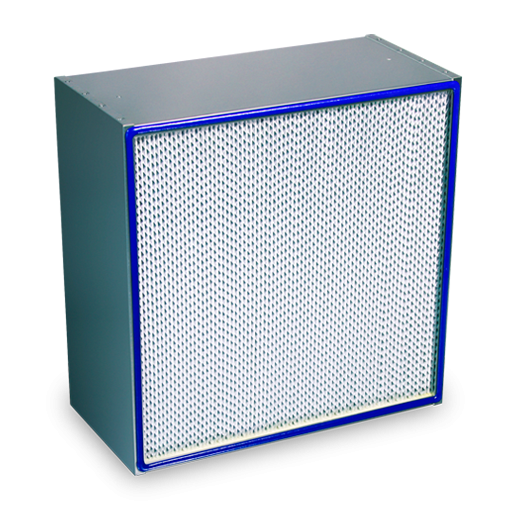
| Aluminium separator | Corrugated aluminium separators as pleat spacers, with HT media up to 250 °C | HS-Mikro S, HS-Mikro R | E11 to H14, special cases up to U15 | Nuclear technology, containment housings, high temperature, special designs |
| Minipleat | Thermoplastic spacers, virtually metal-free, optionally completely metal-free, incinerable | HS-Mikro SF, HS-Mikro RF | E10 to U16, U17 possible | Cleanroom, pharmaceuticals, medicine, process air |
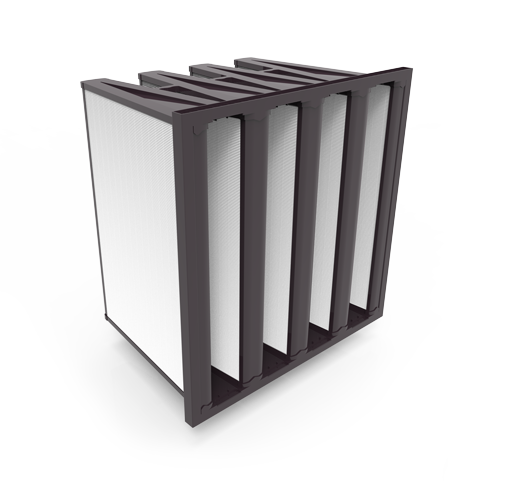
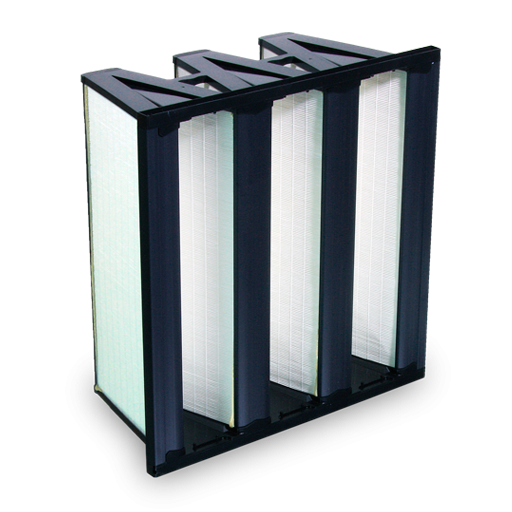
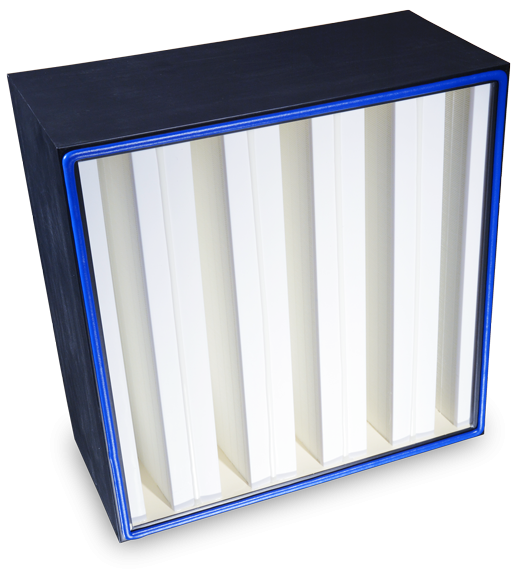
| Minipleat V-form | V-shaped filter packs for the largest filter area per mounting frame | HS-Mikro SFV, HS-Mikro RFV | E11 to H14 | High airflow rates, low pressure drop |
| Laminar flow | Minipleat with aluminium frame, uniform outflow | HS-Mikro SF-AL, HS-Mikro RF-AL | on request | Cleanrooms, operating theatre ceilings, clean benches, microelectronics |
| Compact V-Pak | Compact V-form HEPA filters | HS-V-Pak SFV/RFV, HS-Mikro Pak SFV/RFV, HS-Deka Pak SFV/RFV | E11 to H14 | Mobile filter units, glove boxes, clean benches, upgrade of existing systems |
| Cartridge filter | Cylindrical filter elements for pipelines | HS-Mikroseal JG, HS-Mikroseal JG-S, HS-Mikroseal JK | on request | Tank venting, glove boxes, pneumatic tube systems, pressure equalisation |
| High temperature (minipleat) | Temperature-resistant media and frames up to 120 °C | HS-Mikro SF-HT, HS-Mikro SFV-HT | E11 to H14 | Hot-air sterilisation, dryers, process air |
| ATEX safety filter | Cleanable HEPA filter, ATEX-compliant | HS-Strongshield SF-EX H13 | H13 | Explosion-hazardous areas, maximum burst protection |
Choosing Between Separator and Minipleat
| Criterion | Aluminium separator (HS-Mikro S / R) | Minipleat (HS-Mikro SF / RF / SFV / RFV) |
|---|---|---|
| Filter classes | E11 to H14, special cases up to U15 | E10 to U16, U17 possible |
| Filter area per m² face area | up to 75 m² | V-form up to 110 m², flat up to 90 m² |
| Pressure drop at the same airflow | higher | lower |
| Temperature resistance | up to 250 °C with HT media, in special cases up to 600 °C | up to approx. 65 °C as standard, up to 120 °C as HT version (HS-Mikro SF-HT) |
| Metal-free and incinerable | aluminium separators contain metal | virtually metal-free, optionally completely metal-free |
| Special designs | wide range of options, depths 150 and 292 mm | maximum range of options |
| Nuclear applications | proven within the scope of KTA 1401 and 10CFR50 | possible in almost all applications |
| Recommendation | Nuclear technology, containment housings (BiBO), high temperature above 120 °C, heavy duty | Cleanroom, pharmaceuticals, medicine, process air, energy efficiency |
The larger filter area of the minipleat design reduces the pressure drop at the same airflow and thus the power consumption of your fan over the entire service life. How much this saves in euros depends on the system, airflow and filter medium. The medium has the greatest leverage: with ePTFE membranes, the pressure drop is up to 60 percent lower than with glass fibre media, and the energy costs of the filter stage fall accordingly.
If your process temperature exceeds 120 °C, the aluminium separator with HT media is the right design, up to 250 °C, in special cases up to 600 °C. Below that, the minipleat version HS-Mikro SF-HT covers the range more energy-efficiently.
V-Form for High Airflow Rates
The HS-Mikro SFV/RFV combine minipleat technology with a V-shaped arrangement of the filter packs. This creates a filter area of up to 110 m² per m² face area in the same mounting frame. For ventilation systems with high airflow rates this means: lower pressure drop over the entire service life and lower energy consumption of the fan.
HS-Mikro Pak SFV/RFV and HS-Deka Pak SFV/RFV are upgrade solutions for existing systems. They fit bag filter mounting frames and raise filtration performance to EPA or HEPA level, provided the fan and the leak tightness class of the filter system allow it. For new systems, they are not the standard choice.
Designs in detail: HS-Mikro SFV / RFV, HS-Mikro Pak SFV / RFV and HS-Deka Pak SFV / RFV.
The design currently installed in your system determines the upgrade path: see our bag filters and compact filters.
Terminal Filters for Cleanroom Ceilings
Terminal HEPA filters (also called HEPA ceilings) sit as the last filter stage directly at the transition into the cleanroom. There is no duct between filter and room through which particles could subsequently enter the room.
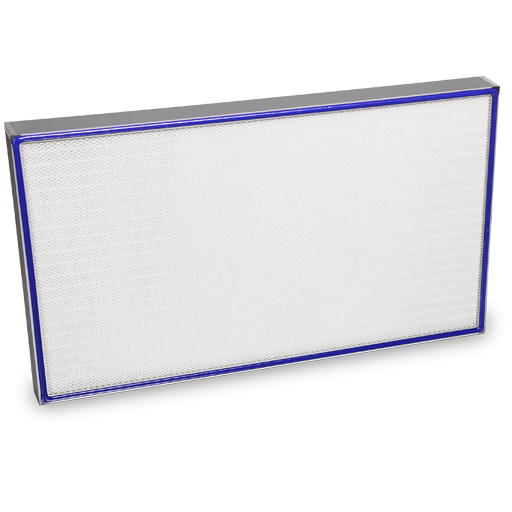
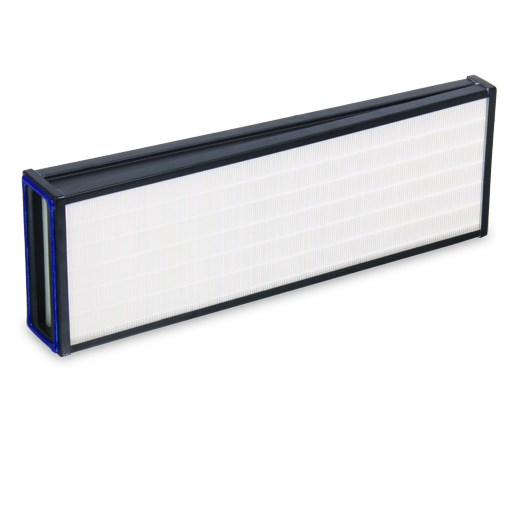
For this position we manufacture the HS-Mikro SF-AL / RF-AL in laminar flow design: minipleat pack in an aluminium frame, optimised for a uniform outflow across the entire filter area. You can verify the uniformity with the optional airflow uniformity test, which we carry out as part of the scan test. This keeps the air velocity across the working area constant, which is decisive for maintaining the cleanroom class at the measuring point. Depths from 30 mm allow installation in shallow ceiling filter housings and fan filter units.
Typical installations: cleanroom ceilings to ISO 14644, operating theatre ceilings to DIN 1946-4, fan filter units, clean benches. For microelectronics we supply the HS-Mikro SF-AL in an ePTFE 0-SVOC version.
Cartridge Filters for Pipelines and Pneumatic Tube Systems
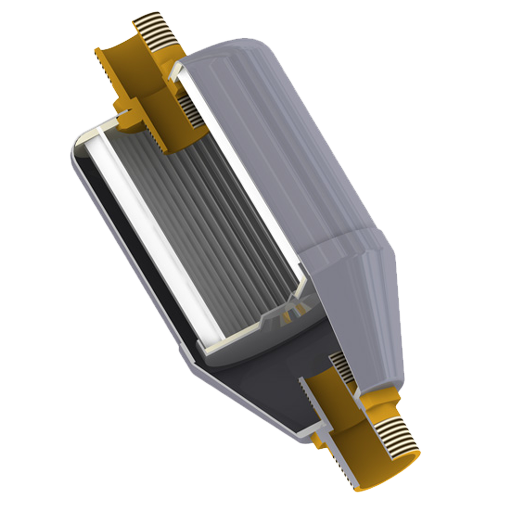
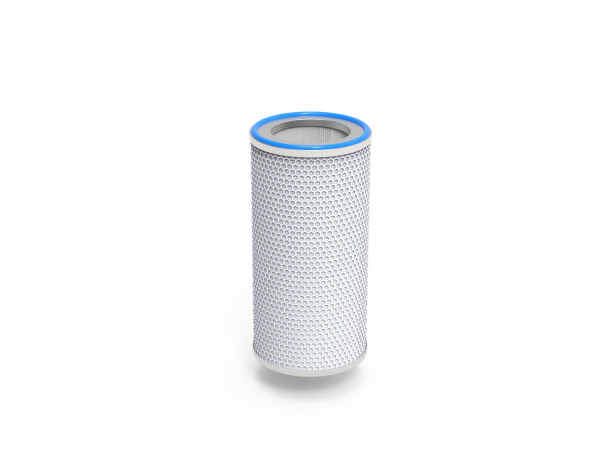
HS-Mikroseal JG, HS-Mikroseal JG-S and HS-Mikroseal JK are cylindrical HEPA filter cartridges for direct installation in pipelines. They filter where there is no space for a rectangular filter housing. This saves you the design of a special housing and the installation space it requires. HS-Mikroseal JG and JG-S withstand a differential pressure of ± 300 mbar.
Applications: tank venting, pressure equalisation on glove boxes, pneumatic tube systems in hospitals and laboratories, venting of contaminated containers and safety filter systems.
High-Temperature and ATEX Versions
For hot-air sterilisation, dryers and hot process air we offer two options: the custom-built minipleat filters HS-Mikro SF-HT and HS-Mikro SFV-HT with HT media up to 120 °C, and the aluminium separator HS-Mikro S / R with HT media up to 250 °C, in special cases up to 600 °C. This saves you a cooling section upstream of the filter stage. We build both HT versions project-specifically to your operating temperature.
In explosion-hazardous areas, the HS-Strongshield SF-EX H13 is used: a cleanable HEPA safety filter, ATEX-compliant, with maximum burst protection and designed for high dust loads. Thanks to its cleanability, the replacement interval is extended even with heavy dust loads.
Filter Media, Potting and Gaskets
The filter medium determines the separation performance. We use two types of media:
Microglass fibre paper is the standard medium for HEPA filters. Ultrafine glass fibres with a diameter below one micrometre form a dense filter web, available in grades for all filter classes from E10 to U17. The medium is thermally stable and keeps filter performance constant over the entire service life, so your readings are still within the design range at the end of the service life.
ePTFE membranes made of expanded polytetrafluoroethylene are the alternative for applications where glass fibre is not permitted, for example in the food industry or semiconductor manufacturing. ePTFE lowers the pressure drop by up to 60 percent compared with glass fibre media and is chemically resistant to disinfectants, hydrogen peroxide (H2O2), formic acid and many other media. This matters wherever cleanrooms are decontaminated with H2O2 or cleaned with disinfectants.
All HS HEPA filters are potted with a permanently elastic plastic that seals the connection between filter medium and frame permanently. Gaskets in various materials and profiles are applied on one or both sides.
For safety-relevant installations we supply filters with a test groove gasket. It lets you check the bypass-free seat in the installed state, without removing the filter.
Individual Testing: Scan Test and Oil Thread Test
The effectiveness of a HEPA filter is determined by its tightness. Even the smallest leaks in potting, gasket or filter medium reduce the entire separation performance, which is why EN 1822 requires performance testing of each individual filter element for HEPA filters (H13, H14) and ULPA filters (U15 to U17).
How the Scan Test Works
In the scan test to EN 1822 / ISO 29463, the test filter is challenged at nominal airflow with a test aerosol whose mean particle size corresponds to the MPPS. A movable probe scans the entire clean-air side of the filter in a standardised pattern and measures the local particle concentrations, while the upstream concentration is monitored on the raw-air side.
These measurements yield the integral efficiency (overall performance) and the local efficiency (weakest point). Both must meet the limits of the respective filter class. Our scan test laboratory in Kiel works under controlled conditions for airflow, temperature and humidity. As an option, we add an airflow uniformity test to the scan test, which verifies uniform air distribution across the filter area for sensitive applications.
Oil Thread Test to EN 1822-4
For HEPA filters of classes H13 and H14, the standard permits a visual test method. An oil mist generator produces an aerosol in the particle size range of 0.2 to 0.5 micrometres, which is passed through the horizontally clamped test filter. A special light source makes any escaping particle streams visible as rising threads of mist against a contrasting background.
The oil thread test is limited to class H14 at most and is mainly used for industrial filters, as well as for the integrity test immediately before installation. With our mobile test system HS-Fogtester we carry out this test on your site, so that any transport damage is detected before installation.
Scan Test or In-Situ Leak Test
In addition to the manufacturer's scan test, operators often carry out an in-situ leak test to ISO 14644-3. The two methods answer different questions:
| Scan test (EN 1822 / ISO 29463) | In-situ leak test (ISO 14644-3) | |
|---|---|---|
| Location | Test laboratory under controlled conditions | Installed state at the operator's site |
| Result | Classification E10 to U17 | Tight or leaking |
| Influencing factors | Airflow, temperature and humidity are controlled | Movement of people, machine activity and temperature fluctuations affect the result |
| Purpose | Proof of filter performance ex works | Proof of leak-free and bypass-free installation |
A filter cannot be classified by an in-situ leak test. The scan test proves the performance of the filter, the in-situ test its correct seat in your system. For your documentation you usually need both.
Discuss scan test and test scope
Filter Housings and Containment Housings
A HEPA filter only achieves its documented performance in a tight housing. We supply filter and housing as a system solution, so responsibility for the seal seat stays with one contact:
- Housings for HEPA filters in duct design for supply and exhaust air, with seal seat for groove gasket or gel seal
- Ceiling filter housings for terminal filters in cleanroom and operating theatre ceilings, designed for uniform outflow
- Safe-change housings (BiBO, bag-in/bag-out) for contamination-free filter changes with pathogenic, toxic or radioactive dusts. Your service staff change the filter without full protective equipment.
- HEPA containment housings and safety filter systems for nuclear facilities and BSL laboratories
- Housings with test ports for recurring in-situ leak testing to ISO 14644-3 during operation, without shutting down the system
Each housing is designed for your airflow, the filter design and the required leak tightness class.
Filter housings and accessories
Applications for HEPA and ULPA Filters
HEPA filters are used where air quality decides on product safety, personal protection or process yield, on the supply and the exhaust side. The result is measured by the cleanliness of the room air during operation. Which filter class, design and pre-filtration are common in your field of application can be found on the respective application pages.
| Application | Suitable HS filters | Details |
|---|---|---|
| Cleanroom, medicine and pharmaceuticals (ISO 14644, GMP, DIN 1946-4, hospitals, laboratory and semiconductor ventilation) | HS-Mikro SF-AL, HS-Mikro SF/RF, HS-Mikro S/R | Clean room & Pharma |
| Microelectronics (cleanrooms with SVOC requirements) | HS-Mikro SF-AL in ePTFE 0-SVOC version | Clean room & Pharma |
| Industry and process air (surface technology, high temperature, ATEX, toxic exhaust air) | HS-Strongshield SF-EX H13, HS-Mikro SF-HT, HS-Mikro S/R | Industry |
| HVAC (air handling units, VDI 6022, production halls in three-shift operation) | HS-Mikro SFV/RFV, as upgrade HS-Mikro Pak SFV/RFV and HS-Deka Pak SFV/RFV | Climate & Ventilation |
| Power generation, offshore and nuclear technology (scope of KTA 1401, safety filter systems, decommissioning) | HS-Mikro S/R, HS-Mikro SF and SFV, HS-Mikroseal JG | Power Gen & Offshore |
| Food and beverage production (aseptic filling, sterile air) | HS-Mikro SF (incinerable), ePTFE versions | Food Production |
| Data centres and server rooms (low pressure drop, high availability) | HS-Mikro SFV/RFV, HS-Mikro Pak SFV/RFV | Data Center |
Discuss a filter solution for your application
Pre-Filtration Secures the Service Life
HEPA filters are the most expensive filter stage of a system. Well-dimensioned pre-filtration to ISO 16890 protects HEPA and ULPA filters from premature loading: in cleanroom applications with three-stage pre-filtration, HEPA filters reach service lives of 3 to 5 years, with two-stage pre-filtration 1 to 3 years. Over the life cycle of your system, the pre-filter stage therefore determines the filter costs of the final stage.
Recommended Filter Stages per Final Filter
| Final filter | Recommended pre-filtration | HS products for the pre-filter stages |
|---|---|---|
| EPA (E10 to E12) | 1st stage ISO Coarse / ePM10, 2nd stage ePM1 55 to 85 % | HS-Alpha Pak + HS-Pak 88 or HS-Mikro Pak 4V |
| HEPA (H13 to H14) | 1st stage ISO Coarse / ePM10, 2nd stage ePM1 80 % and higher | HS-Alpha Pak + HS-Pak 95 or HS-Mikro Pak 4V PPE |
| ULPA (U15 to U17) | 1st stage ISO Coarse / ePM10, 2nd stage ePM1 80 % and higher, 3rd stage EPA E11/E12 as intermediate stage | HS-Alpha Pak + HS-Mikro Pak + HS-Mikro Pak RFV (E11) |
The pre-filter stages in detail: bag filters to ISO 16890 such as HS-Pak 88 and HS-Pak 95, and compact filters such as HS-Mikro Pak 4V and HS-Mikro Pak 4V PPE.
Upgrading Existing Systems to HEPA Level
HS-Mikro Pak SFV/RFV and HS-Deka Pak SFV/RFV in EPA or HEPA version fit existing bag filter mounting frames. This lets you increase the filtration performance of an existing system without structural changes to the filter housing or ventilation system. The conversion can be scheduled into a regular maintenance date.
The upgrade is a compromise between pressure drop and system tightness. Many existing systems are not equipped for higher filter classes, in which case the efficiency is only achieved nominally. Before the change, we therefore check two points with you: the reserve of your fan at a higher final pressure drop and the leak tightness class of the existing filter housing.
HS HEPA Filter Product Overview
| HS product | Design | Classes (EN 1822) | Std. depth [mm] | Features |
|---|---|---|---|---|
| HS-Mikro S / R | Separator | E11 to H14, special cases up to U15 | 150 / 292 | Maximum range of options, nuclear technology, with HT media up to 250 °C, in special cases up to 600 °C |
| HS-Mikro SF / RF | Minipleat | E10 to U16, U17 possible | 66 / 78 / 150 / 292 | Virtually metal-free, optionally completely metal-free, incinerable, universal use |
| HS-Mikro SF-AL / RF-AL | Laminar flow | on request | 30 to 150 | Uniform outflow for cleanrooms, operating theatre ceilings, clean benches. ePTFE version 0-SVOC for microelectronics |
| HS-Mikro SFV / RFV | Minipleat V-form | E11 to H14 | 292 | Up to 110 m² filter area per m² face area, high airflow rates |
| HS-Mikro Pak SFV / RFV | Compact V-form | E11 to H13 | 292 | Upgrade solution for existing systems, fits bag filter frames |
| HS-Deka Pak SFV / RFV | Compact V-form | E11 to H13 | 420 | Upgrade solution for existing systems |
| HS-V-Pak SFV / RFV | Compact V-form | E11 to H14 | on request | Compact, for mobile filter units, glove boxes, clean benches |
| HS-Mikro SF-HT | Minipleat high temperature | E11 to H14 | 150 / 292 | Custom-built with HT media, temperature-resistant up to 120 °C |
| HS-Mikro SFV-HT | V-form high temperature | E11 to H14 | 292 | Custom-built with HT media, V-form, temperature-resistant up to 120 °C |
| HS-Mikroseal JG | Cartridge filter | on request | variable | Pressure relief, tank venting, glove boxes |
| HS-Mikroseal JG-S | Cartridge filter | on request | variable | Installation in pipelines, ± 300 mbar |
| HS-Mikroseal JK | Cartridge filter | on request | variable | New in our range |
| HS-Strongshield SF-EX H13 | ATEX safety filter | H13 | 292 | Cleanable, ATEX-compliant, maximum burst protection, high dust loads |
Options for all designs: metal frames, special gaskets (gel, flat gasket, round cord), test groove gasket for seal seat testing, finger guards, handles, flanges, cleanable filter media and customer-specific dimensions. Standard temperature resistance up to approx. 65 °C, as minipleat HT version up to 120 °C, as aluminium separator filter with HT media up to 250 °C, in special cases up to 600 °C.
Selected standard filters are available in our online shop shop.luftfilterbau.de.
HEPA Filters from Kiel: Testing, Delivery and Service
- Overnight production: if your order reaches us with urgency on a working day before 12:00 noon, we manufacture overnight. In the event of an unplanned plant shutdown, this shortens your production downtime.
- Framework agreements: your filters are held in stock and dispatched the next day.
- Plant-specific labelling at no extra charge: your plant designations appear on the pallet, outer packaging and product label. During maintenance, you can assign each filter to its position quickly and reliably.
- Filter engineering: our filter engineering team advises you and plans the product right through to production, according to the dimensions, geometry and function of your system. For complex system questions, we optionally calculate the airflow by CFD simulation.
- Service team: professional installation, hygienic acceptance testing and maintenance on site, also on Sundays and public holidays, by a team holding all necessary certificates, for example a radiation passport.
Test Report with Serial Number
From class H13 upwards, we test every filter individually to EN 1822-4. For H13 and H14, you order the scan test together with the filter; for cleanroom applications we strongly recommend it. From U15, the scan test is mandatory and the test report obligatory.
The report documents the integral efficiency, the local efficiency, the nominal airflow, the initial pressure drop and all test conditions for airflow, temperature and humidity. It applies to exactly this filter element with this serial number. You receive it on request, also retrospectively. For quality managers in pharmaceuticals, microbiology and medical technology, this is the evidence that stands up in qualification documentation.
Standards and Certifications
- Testing to DIN EN 1822 and ISO 29463 in our own scan test laboratory in Kiel
- Nuclear technology: filters for facilities within the scope of KTA 1401. For international projects, we obtain 10CFR50 and GOST certification as required for the duration of the project.
ISO 9001 and ISO 14001 certified, environmental management since the late 1990s. Both certificates can be downloaded from our company page and can therefore be used for your supplier assessment. We test and classify according to ISO, EN and DIN because these standards are freely accessible and independently verifiable for you.
Request HEPA Filters
Selected standard filters are available in our online shop shop.luftfilterbau.de.
For custom-built filters, projects with scan test requirements, nuclear specifications or technical advice, please contact us directly:
- Phone: +49 431 71953-0
- E-mail: info@luftfilterbau.de
Ideally have the following ready: dimensions, filter class, airflow, operating temperature and type of seal seat. If any of this information is missing, we will clarify it together on the phone.
Frequently Asked Questions About HEPA Filters
What is a HEPA filter?
A HEPA filter (High Efficiency Particulate Air filter) is a particulate air filter that, according to EN 1822, captures at least 99.95 percent (class H13) or 99.995 percent (class H14) of all particles at the MPPS. The MPPS is the particle size that fibre-based filters capture least effectively and typically lies between 0.1 and 0.3 micrometres. Larger and smaller particles are retained with a higher efficiency. HEPA filters retain viruses, bacteria, germs, fine dust, toxic dusts and radioactive aerosols. From class H13, every filter is tested individually.
What is the difference between EPA, HEPA and ULPA?
The three groups differ in their efficiency at the MPPS and in the test method. EPA filters (E10 to E12) capture 85 to 99.5 percent and are classified by type testing. HEPA filters (H13 to H14) capture 99.95 to 99.995 percent, ULPA filters (U15 to U17) 99.9995 to 99.999995 percent. For HEPA and ULPA filters, EN 1822 requires individual testing of each filter element, from U15 as a scan test. Classification is carried out according to EN 1822 and ISO 29463.
What does MPPS mean for HEPA filters?
MPPS stands for Most Penetrating Particle Size, the particle size that fibre-based filters capture least effectively. Depending on the filter configuration, it typically lies between 0.1 and 0.3 micrometres. For smaller particles, diffusion dominates; for larger ones, inertial impaction and interception. Larger and smaller particles are therefore retained with a higher efficiency. EN 1822 classifies HEPA filters specifically at the MPPS, which is why the stated efficiency is the least favourable value across the entire particle spectrum.
What is a scan test and why is it important?
The scan test is the test method according to EN 1822 and ISO 29463 in which every single HEPA or ULPA filter element is tested for separation performance and leak tightness under laboratory conditions. A movable probe scans the entire clean-air side of the filter and measures the local particle concentrations. For H13 and H14 the scan test is optional, from U15 mandatory. It does not replace on-site testing, but it ensures that no deviation from the factory interrupts or extends your maintenance date. Otherwise, systems whose filters fail on-site qualification stay down longer. HS-Luftfilterbau GmbH operates its own scan test laboratory in Kiel and supplies the test report with serial number on request, also retrospectively.
When do I need separator filters, when minipleat?
Separator filters with corrugated aluminium separators (HS-Mikro S/R) are the choice for nuclear applications, for operating temperatures above 120 °C up to 250 °C with HT media, in special cases up to 600 °C, and for special designs with a wide range of options. Minipleat filters (HS-Mikro SF/RF/SFV/RFV) achieve a larger filter area with the same frame size (V-form up to 110 m², flat up to 90 m², compared with up to 75 m² per m² face area for the separator), work with a lower pressure drop and are virtually metal-free and incinerable. They are suitable for cleanrooms, pharmaceuticals, medicine and all applications focusing on energy efficiency. For hot process air up to 120 °C, the minipleat version HS-Mikro SF-HT is available.
Can HEPA filters replace existing bag filters?
To a limited extent. The upgrade is always a compromise between pressure drop and system tightness. With the HS-Mikro Pak SFV/RFV and HS-Deka Pak SFV/RFV, HS-Luftfilterbau GmbH manufactures compact HEPA filters in V-form design that fit standard bag filter mounting frames. However, many existing systems are not equipped for higher filter classes, in which case the efficiency is only achieved nominally. Before conversion, check the reserve of the fan at a higher final pressure drop and the leak tightness class of the filter housing.
How long does a HEPA filter last?
The service life depends on the quality of pre-filtration and the dust load. In cleanroom applications with three-stage pre-filtration, service lives of 3 to 5 years are common, in standard applications with two-stage pre-filtration 1 to 3 years. On the exhaust side in heavily loaded environments, replacement intervals are shorter. The replacement date is determined by the final pressure drop; continuous differential pressure monitoring makes it plannable. In nuclear facilities, KTA 3601 applies: HEPA filters must undergo a functional test after 27,000 operating hours at the latest and be replaced after 9 years of use at the latest.
Which HS HEPA filters are suitable for nuclear technology?
For nuclear safety filter systems within the scope of KTA 1401, operators worldwide use the HS-Mikro S/R with aluminium separator technology, as well as the minipleat filters HS-Mikro SF and HS-Mikro SFV. HS-Luftfilterbau GmbH supplies to 10CFR50 as required. In addition, HS-Mikroseal JG cartridge filters provide the required tightness for positive and negative pressure equalisation in contaminated areas. HS mobile filter units equipped with HEPA filters have proven themselves in numerous nuclear applications.
How are HS HEPA filters disposed of?
The disposal route is determined by the captured material: if the filter has absorbed hazardous substances, the waste code is determined by these substances. Without hazardous substances, the separator filters HS-Mikro R and HS-Mikro S can also be disposed of as general commercial waste. The minipleat versions HS-Mikro SF, HS-Mikro SFV, HS-Mikro Pak SFV and HS-Deka Pak SFV with MDF or plastic frames and thermoplastic spacers are virtually metal-free, optionally completely metal-free, and incinerable. This reduces disposal costs for contaminated filters. The laminar flow version HS-Mikro SF-AL with aluminium frame can be separated by material type; the aluminium is recyclable.
