Bag Filters for Ventilation and Air Conditioning Systems
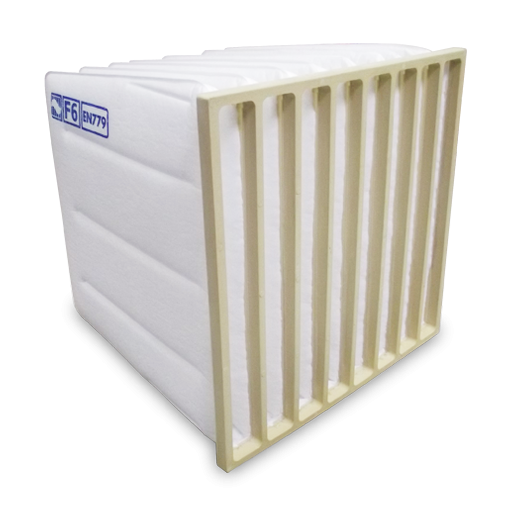
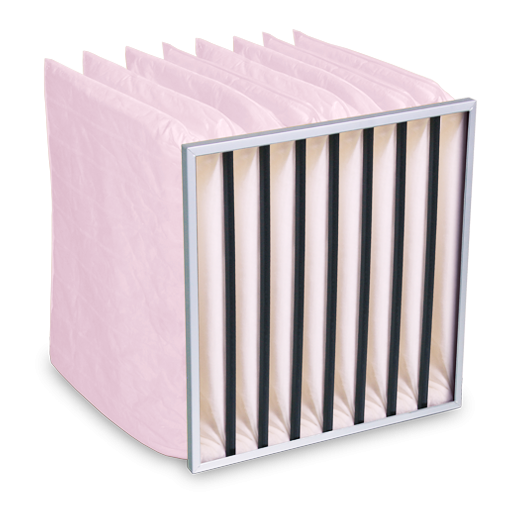
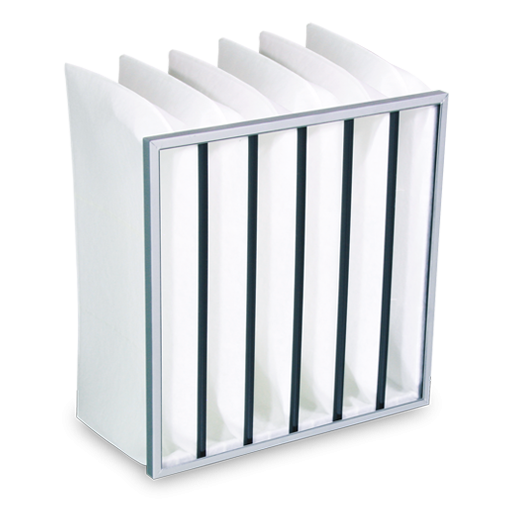
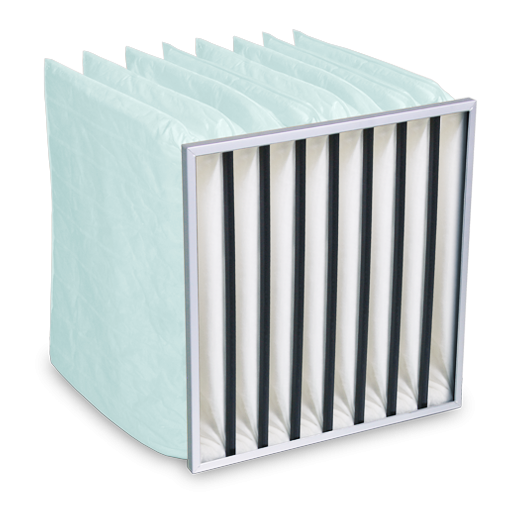
Bag filters are air filters for ventilation systems and air conditioning systems whose filter medium is sewn into wedge-shaped filter pockets and fixed in a front frame. They capture particles in the depth of the medium and store them there until the permissible final differential pressure is reached. They are classified to ISO 16890 in the groups ISO Coarse, ePM10, ePM2.5 and ePM1.
HS-Luftfilterbau GmbH manufactures bag filters in Kiel, Germany, from coarse dust pre-filtration (ISO Coarse) up to fine dust filtration of class ePM1 95 %. The standard series is completely glass-fibre-free and its performance values are documented to ISO 16890. You receive filters whose class you can adopt directly in tender documents and system documentation.
Already know the class required to ISO 16890? Filter bag filters in the product finder

What Is a Bag Filter?
Bag filters are among the most widely used filter types in heating, ventilation and air conditioning (HVAC). In the airflow the pockets inflate and form an evenly flowed-through filter area. The pocket shape accommodates a large active area in a compact space, which gives this filter type its cost structure: low purchase price with high dust holding capacity.
Bag filters work as depth filters. Particles penetrate the medium and are deposited across the entire material thickness. This results in the high dust holding capacity and the long service life. The pressure drop rises only gradually over the service life until the recommended final differential pressure is reached.
Bag Filter, Pocket Filter and Filter Bag: One Component, Several Names
Bag filter and pocket filter refer to the same component. Also common are filter pockets, filter bags and the German terms Taschenfilter and Beutelfilter. All variants appear in tenders and spare parts lists. For ordering, filter class, dimensions and depth are what count.
Structure of Filter Pocket, Medium and Frame
The filter medium of the HS bag filters is fully synthetic. In the fine dust classes we use meltblown media, comparable to the media in FFP2 masks, and needle-punched fibres for the ISO Coarse classes. The number of pockets varies with size and filter class, 5 to 10 pockets per filter element are common. The wedge shape keeps the pockets away from the duct wall during operation.
- Front frame made of galvanised steel sheet, stainless steel or plastic: The frame material is matched to the installation situation, for example stainless steel for humid supply air areas.
- Corrosion-resistant plastic gasket between pocket and frame: holds the individual pockets in the filter frame and prevents leaks at the seam.
- Fully synthetic filter material: offers bacteria and mould no nutrient base and remains dimensionally stable when air humidity fluctuates. Glass fibre media, by contrast, can change their structure irreversibly under the influence of moisture.
Filter Classes to ISO 16890
ISO 16890 has been the authoritative standard for the classification of air filters in general ventilation and air conditioning since 2017, and EN 779 was withdrawn in 2018. The standard rates the filtration efficiency for three particle size fractions: ePM1 (0.3 to 1 micrometre), ePM2.5 (0.3 to 2.5 micrometres) and ePM10 (0.3 to 10 micrometres). It measures the filtration efficiency also after electrostatic discharge of the medium and thus reflects the long-term performance in operation.
The designation ePM1 55 % means that after this discharge the filter captures at least 55 percent of the particles from 0.3 to 1 micrometre. ePM1 has the strongest influence on indoor air quality (IAQ), because particles of this size are respirable.
Further information on the classification can be found at www.ISO16890.info.
HS-Pak and HS-AirSynErgy at a Glance
| HS bag filter | ISO 16890 class | Old EN 779 class | Typical application | Recommended filter stage |
|---|---|---|---|---|
| HS-Pak 25 | ISO Coarse 60 % | G3 | Coarse pre-filtration, industrial exhaust air | 1st stage |
| HS-Pak 35 | ISO Coarse 90 % | G4 | Pre-filtration in air conditioning and ventilation systems | 1st stage |
| HS-Pak 55 | ePM10 55 % | M5, formerly F5 | General supply air filtration as pre-filter stage | 1st or 2nd stage |
| HS-Pak 65 | ePM2.5 65 % | M6, formerly F6 | Pre-filtration or supply air filtration with moderate air quality requirements | 1st or 2nd stage |
| HS-Pak 88 | ePM1 55 % to 65 % | F7 | Main filtration in offices, pre-filtration for laboratories, pharma, food | 2nd stage, main filter |
| HS-Pak 95 | ePM1 80 % to 95 % | F9 | Fine dust filtration ePM1 80 % and higher, pre-filter for HEPA | 2nd stage, pre-filter for HEPA |
| HS-AirSynErgy 88 | ePM1 55 % to 65 % | F7 | Energy-optimised main filtration | 2nd stage, main filter |
| HS-AirSynErgy 95 | ePM1 80 % to 95 % | F9 | Energy-optimised filtration ePM1 80 % and higher | 2nd stage, pre-filter for HEPA |
Converting Old Filter Classes G3 to F9
In existing systems, maintenance plans and spare parts lists the old filter classes to EN 779 are still common. With the revision of EN 779 in 2012, F5 and F6 were converted to M5 and M6. There is no normatively binding conversion between EN 779 and ISO 16890, because the two standards work with different test aerosols and evaluation parameters. The following assignment serves as orientation for filter replacement.
| Old designation | Note | Orientation to ISO 16890 | Suitable HS bag filter |
|---|---|---|---|
| G3 | Coarse dust | ISO Coarse 60 % | HS-Pak 25 |
| G4 | Coarse dust | ISO Coarse 90 % | HS-Pak 35 |
| F5, M5 | F5 converted to M5 in 2012 | ePM10 55 % | HS-Pak 55 |
| F6, M6 | F6 converted to M6 in 2012 | ePM2.5 65 % | HS-Pak 65 |
| F7 | Fine dust | ePM1 50 % to 70 % | HS-Pak 88, HS-AirSynErgy 88 |
| F8 | Fine dust | ePM1 50 % to 70 % | Design on request |
| F9 | Fine dust | ePM1 from 75 % | HS-Pak 95, HS-AirSynErgy 95 |
Anyone looking for a “bag filter F5” today needs a filter of class ePM10 55 %. Between ePM1 55 %, 60 % and 65 % the differences in practice are smaller than the figures suggest, because the actual filtration efficiency depends strongly on loading and operating conditions. You can read the background in our article ePM1 55 %, 60 % or 65 %?
Energy Efficiency and Operating Costs
Over the life of an air filter, the differential pressure counts for more than the purchase price. Every additional pascal of pressure drop must be compensated by the fan and increases the energy consumption of your system. How high the energy share of the life cycle costs turns out to be depends on filter type, replacement interval and ambient conditions and can only be quantified for the specific system.
For orientation we calculate comparable to the Eurovent 4/21 regulations: 6,000 operating hours per year and 60 percent fan efficiency. We deliberately do not seek certification to this manufacturer-bound standard, because our company philosophy stands for open standards and open source. With the same calculation basis you can compare filters of different energy classes with one another.
Calculation Example Based on the Eurovent Energy Model
A bag filter of class ePM1 60 % requires, according to the Eurovent 4/21 energy model, around 950 kWh per year in energy class A. At 0.32 euros per kWh this amounts to around 300 euros in energy costs. A filter of the same filter class in energy class C causes 464 euros. The saving is around 164 euros per filter per year. The additional price of the class A filter is 10 to 15 euros and is recovered on annual average after around one month of operation. Large systems work with dozens to hundreds of filters, so the saving grows with every filter position. The energy classes serve as orientation in the calculation example and do not designate a classification of our filters.
HS-AirSynErgy with More Than Double the Filter Area
The HS-AirSynErgy series uses a patented wave structure of the filter medium and thus provides more than double the active filter area of a conventional bag filter. The following values each apply in comparison with a conventional bag filter:
- Up to 35 percent lower differential pressure: reduces the power consumption of controlled fans over the entire service life, as they are standard in modern systems
- Up to 80 percent higher dust holding capacity: extends the replacement intervals and saves maintenance visits
- Up to 30 percent lower operating costs: at the purchase cost of a bag filter
Filter Staging Reduces Energy Demand
A suitably dimensioned pre-filter such as the HS-Pak 35 or a panel filter captures coarse dust in the supply air at an early stage. As a result the main filter loads more slowly, its differential pressure rises more gradually and its service life extends. Upstream of an activated carbon stage the bag filter keeps fine dust and particulate air contaminants away from the activated carbon and preserves its adsorption capacity. Upstream of particulate air filters an HS-Pak 95 of class ePM1 80 % and higher takes on this task and extends the service life of the particulate air filter in the final stage.
Panel filters and HS-Alpha Pak · Molecular and gas filters · EPA, HEPA and ULPA filters · Multi-stage filter concepts for HVAC systems
Bag Filters or Compact Filters
Both designs overlap in the class range up to ePM1 85 %; above that, bag filters reach up to ePM1 95 %. For standard applications with sufficient installation depth, the bag filter offers the more economical combination of purchase and operating costs, with the HS-AirSynErgy series at the energy level of a compact filter. For limited installation depth or very high air volumes, the compact filter is the suitable design.
The full comparison of installation depth, pressure drop, dust holding capacity and costs: Compact filters and bag filters compared
Dimensions, Frames and Installation
Standard Sizes and Special Sizes
HS bag filters are available in all common standard sizes. The dimensions are stated as width times height in millimetres, followed by the depth. The most common size is 592 × 592 × 600 mm.
| Width × height [mm] | Depths [mm] | Frame options |
|---|---|---|
| 287 × 592 | 360 / 500 / 600 | Metal frame 20 or 25 mm, galvanised or stainless steel. Plastic frame 25 mm. Optionally with hygiene gasket. |
| 490 × 592 | 360 / 500 / 600 | |
| 592 × 287 | 360 / 500 / 600 | |
| 592 × 490 | 360 / 500 / 600 | |
| 592 × 592 | 360 / 500 / 600 | |
| Special sizes | on request |
For dimensions, geometry and function we develop a tailor-made solution with you. With existing systems that have deviating frame dimensions, the system remains untouched.
Frames, Gaskets and Housings
The performance of a filter stage depends on a tight fit in the mounting frame. Leaks cause bypass leakage, where unfiltered air passes the filter into the supply air.
- Metal frame 20 or 25 mm, galvanised or stainless steel: dimensionally stable at high air volume flows, stainless steel for humid and corrosive environments
- Plastic frame 25 mm: lighter during filter replacement and fully incinerable, which simplifies disposal
- Foamed hygiene gasket on the front frame, optional: The gasket is renewed with every filter replacement. The periodic gasket replacement in the mounting frame required under VDI 6022 is no longer necessary.
HS bag filters fit standard mounting frames. For new builds and retrofits we supply the frame system. Filter, frame and housing are matched as a system solution, the sealing profiles fit without rework.
HS mounting frame for bag and compact filters · Filter wall type HS-T021 · Duct filter type HS-T022 · HS-Vario CAT · Overview of filter housings
Special Designs for Critical Areas
All special designs can be combined with special sizes.
- Antistatic design for EX zones: The conductivity of medium and frame prevents electrostatic charging in the filter cake on the filter surface. Typical places of use are paint shops and spray booths.
- Biostatic design for food-related areas: The treated medium inhibits the growth of bacteria and mould in the filter and supports the hygiene requirements of VDI 6022 for supply air filtration.
- Fully incinerable design: The filter burns almost without residue in thermal recovery. For operators with sustainability reporting obligations, disposability is a documentable factor.
- Grease and oil mist pre-filtration in exhaust air: Liquid aerosols from kitchen and process exhaust air are captured by the HS-Pak 55 PA before they deposit in ducts and on the fan. It belongs to the grease and oil mist filters and complements the bag filter stage in exhaust air filtration.
Applications for Bag Filters
Bag filters work in ventilation and air conditioning systems of any size, from pre-filtration at the outdoor air intake to the main filter stage. The industry-specific requirements can be found on the respective application pages.
- Climate and ventilation: office and administration buildings, schools, shopping centres, hotels To the application page
- Clean room, medicine and pharmaceuticals: bag filters as pre-filter stage upstream of particulate air filters To the application page
- Industry and process air filtration: production halls, paint shops, machining processes To the application page
- Food production: hygiene-critical supply air in food processing To the application page
- Data centres: dust-free cooling air with low pressure drop to optimise PUE To the application page
- Power generation and offshore: pre-filtration in salty and humid ambient air To the application page
Discuss a filter solution for your application
Product Overview HS Bag Filters
- Coarse dust bag filters HS-Pak 25 and HS-Pak 35: pre-filtration and main filter stage in applications without hygiene requirements, ISO Coarse 60 % and 90 %
- Medium and fine dust bag filters HS-Pak 55 and HS-Pak 65: pre-filter and main filter stages in air conditioning and ventilation, ePM10 55 % and ePM2.5 65 %
- Fine dust bag filters HS-Pak 88 and HS-Pak 95: main filter stages with ePM1 requirement, ePM1 55 % to 95 %
- Energy-saving bag filters HS-AirSynErgy 88 and HS-AirSynErgy 95: longer service life with lower pressure drop
- HS-Pak 55 Extreme and HS-Pak 65 Extreme: rigidly welded filter pockets for turbomachinery and surface technology
- Guide: Synthetic or Fibreglass Bag Filters: decision aid for operators, engineering and purchasing
Standard sizes can be ordered directly in the web shop at shop.luftfilterbau.de.
Bag Filters from Kiel: Testing, Delivery and Service
- Overnight production: If your order arrives on a working day before 12:00 with a request for urgency, we manufacture overnight. For an unplanned filter change this shortens your system downtime.
- Framework agreements: Your filters are held in stock and ship the next day.
- System-specific labelling at no extra charge: Your system designations appear on the pallet, outer packaging and product label. During maintenance you can quickly assign each filter to its position.
- Filter engineering: Our filter engineers advise you and plan the product through to production, designed for air volume flow, filter class, available depth and installation situation.
- Special designs and standard goods are handled by the same contact.
Testing to ISO 16890
Testing to ISO 16890 is a destructive test. We therefore test repeatedly per product family for filtration efficiency and differential pressure and thereby safeguard the process and quality of ongoing production. Test reports and type test records are available on request, for example for your system documentation or supplier assessment. How our test rig is set up is described in the article ISO 16890 test rig.
Standards and Certifications
ISO 9001 and ISO 14001 are certified, environmental management since the late 1990s. Both certificates can be downloaded from our company page and are therefore verifiable for your supplier assessment. We test and classify to ISO, EN and DIN, because these standards are publicly available and independently verifiable by you.
Request Bag Filters
For projects, custom sizes and framework agreements our filter engineers design the suitable filter for your system:
- Phone: +49 431 71953-0
- Email: info@luftfilterbau.de
For the design we need: air volume flow, required filter class, available depth and installation situation. If you are missing one of these details, we clarify it together by phone.
Frequently Asked Questions About Bag Filters
Is a Pocket Filter the Same as a Bag Filter?
Yes. Bag filter and pocket filter refer to the same filter type with wedge-shaped sewn filter pockets in a front frame. Also common are filter pockets, filter bags and the German terms Taschenfilter and Beutelfilter. For ordering, filter class to ISO 16890, dimensions and depth are decisive.
How Often Does a Bag Filter Have to Be Replaced?
As a guideline, 6 to 12 months apply for ePM1 bag filters in standard office buildings. The actual service life depends on dust load, air volume flow and filter class. What counts for the replacement is the recommended final differential pressure, which as a guideline is 200 to 300 pascals depending on filter class and system. VDI 6022 additionally requires a visual inspection as part of the regular hygiene inspection.
Which Filter Class Corresponds to F5, F6 or G4?
With the revision of EN 779 in 2012, F5 and F6 were converted to M5 and M6. According to ISO 16890, M5 corresponds approximately to ePM10 55 % (HS-Pak 55), M6 to ePM2.5 65 % (HS-Pak 65) and G4 to ISO Coarse 90 % (HS-Pak 35). There is no normatively binding conversion between the standards, because they work with different test aerosols. For filter replacement in existing systems the assignment is suitable as orientation.
What Is the Difference Between ISO 16890 and EN 779?
EN 779 classified coarse dust filters (G1 to G4) by the gravimetric arrestance: the filter was loaded with ASHRAE test dust up to the standard final differential pressure, and the ratio of weight gain to dust fed in gave the arrestance. Fine dust filters (M5 to F9) were rated by an average efficiency at a particle size of 0.4 micrometres. ISO 16890 has applied since 2017 and rates the filtration efficiency separately for ePM1, ePM2.5 and ePM10. It also measures after electrostatic discharge of the medium and thus reflects the long-term performance in operation. EN 779 was withdrawn in 2018.
What Does ePM1 55 Percent Mean?
After electrostatic discharge the filter captures at least 55 percent of the particles from 0.3 to 1 micrometre. In practice the differences between ePM1 55 %, 60 % and 65 % within the same group are smaller than the figures suggest, because the actual filtration efficiency depends strongly on loading and operating conditions.
Are Glass Fibre Filters Better Than Synthetic Filters?
Not across the board. Glass fibre and synthetic media differ in initial efficiency, breakage behaviour and moisture behaviour. Glass fibre media achieve a high purely mechanical initial efficiency, because they do without electrostatic effects. They are prone to breakage, and fibre fragments that irritate the respiratory tract and skin can be released during transport and installation. Under the influence of moisture, glass fibre media can change their structure irreversibly, and the filter resistance then remains permanently increased. Synthetic media are break-resistant and reach classes up to ePM1 95 % to ISO 16890. HS-Luftfilterbau GmbH uses exclusively synthetic media in the bag filter standard series, as meltblown or needle-punched fibres. The detailed comparison is in the guide Synthetic or Fibreglass Bag Filters
Which Bag Filter Suits My Application?
The selection depends on the required air quality and the function of the filter in the system. For pre-filtration a coarse dust filter of class ISO Coarse is sufficient, for example the HS-Pak 35. For supply air filtration in office buildings at least an ePM1 filter is envisaged, for example HS-Pak 88 or HS-AirSynErgy 88. As a pre-filter for HEPA particulate air filters a filter of class ePM1 80 % and higher is suitable, for example the HS-Pak 95. For the design you can reach our filter engineers at +49 431 71953-0.
Can Bag Filters Be Ordered in Special Sizes?
Yes. For dimensions, geometry and function we develop a tailor-made solution with you. Biostatic designs for food-related areas, antistatic designs for EX zones and incinerable designs are also available. We accept special enquiries at info@luftfilterbau.de.
How Do I Reduce the Energy Costs of Air Filtration?
The energy costs of a filter stage are determined above all by the differential pressure of the filter. Filters with a lower pressure drop at the same filtration efficiency directly reduce the power consumption of controlled fans. With more than double the active filter area, the HS-AirSynErgy series achieves up to 35 percent lower differential pressures than conventional bag filters. The second contribution comes from needs-based filter staging: a suitably dimensioned pre-filter such as the HS-Pak 35 extends the service life of the main filter and reduces the total energy consumption of the filter section.
