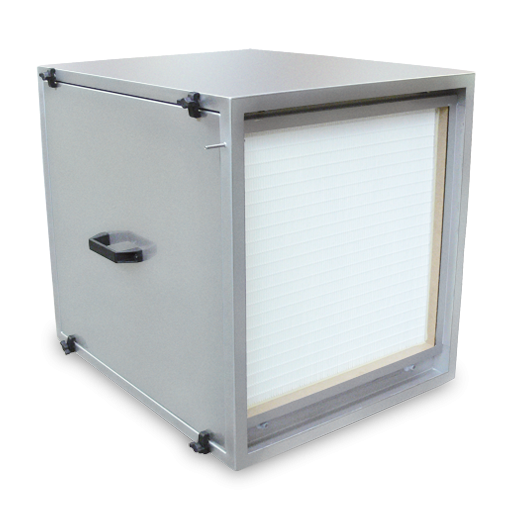
Clean rooms, medical & pharmaceutical applications
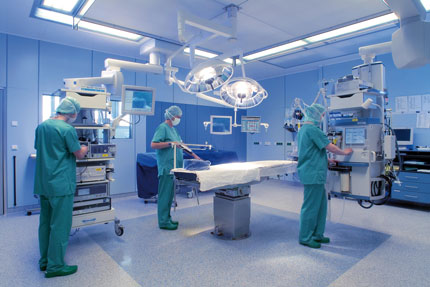
In cleanrooms, hospitals, pharmaceutical production facilities, and high-containment laboratories, air quality directly determines product safety, patient protection, and process outcomes. Even a small number of particles or molecular contaminants can render an entire production batch unusable, jeopardize a surgical procedure, or distort a research result. Accordingly, the requirements placed on the filters used – and on the manufacturer supplying them – are extremely high.
HS-Luftfilterbau has been one of Germany’s leading manufacturers of HEPA and ULPA filters for more than 50 years. At our Kiel site, we manufacture and test high-efficiency particulate filters for the most sensitive applications – from sterile pharmaceutical production and operating rooms to BSL-4 laboratories and ISO Class 1 cleanrooms in the semiconductor and microelectronics industries. Two fully automated HEPA scanners, the capability to test with DEHS and PSL aerosols, and consistent material monitoring with regard to VOC and SVOC emissions form the foundation for filter products that perform reliably even under the most stringent cleanliness requirements.
Why Air Filtration Is Critical in Cleanroom and Medical Applications
In an ISO Class 5 cleanroom, a maximum of 3,520 particles ≥ 0.5 µm per cubic meter of air is permitted – in ISO Class 1, only 10 particles ≥ 0.1 µm are allowed. By comparison, normal outdoor air contains several million particles per cubic meter. All supply air must therefore be routed through high-efficiency particulate filters (HEPA or ULPA) capable of retaining particles down to the size of the most penetrating particle size (MPPS, typically 0.1–0.3 µm) with an efficiency of 99.95% (H13), 99.995% (H14), or higher.
In medical technology, HEPA filters in operating room ceilings, intensive care units, and isolation rooms protect patients from airborne germs and particles. In pharmaceutical production, they ensure that aseptic filling processes and sterilization areas comply with GMP requirements. In semiconductor manufacturing, molecular cleanliness is also essential: in addition to particles, gaseous contaminants – especially SVOCs (semi-volatile organic compounds) – can interfere with sensitive processes. In such environments, particulate filtration alone is not sufficient; the filter materials themselves must not emit any relevant outgassing substances.
Standards and Regulations
EN 1822 / ISO 29463 – Testing and Classification of High-Efficiency Particulate Filters
EN 1822 is the European standard for testing and classifying EPA, HEPA, and ULPA filters (classes E10 to U17). It defines both the overall filtration efficiency test and the scan test, in which the entire filter surface is systematically scanned for local leaks. Every high-efficiency particulate filter manufactured by HS-Luftfilterbau from class H13 upward is individually tested on our two fully automated HEPA scanners and supplied with an individual test report. We use DEHS (Di-Ethyl-Hexyl-Sebacate) as our standard test aerosol; for semiconductor applications requiring oil-free testing, PSL aerosol (polystyrene latex particles) is available as an alternative.
ISO 14644 – Cleanroom Classification
The ISO 14644 series defines cleanroom classes ISO 1 to ISO 9 according to the maximum permissible particle concentration. It forms the basis for the design of supply air and recirculation filtration systems, airflow concepts (laminar flow vs. turbulent mixing ventilation), and cleanroom qualification. HS-Luftfilterbau regularly supplies HEPA and ULPA filters for cleanrooms up to and including ISO Class 1.
GMP and the EU GMP Guide – Cleanroom Classes A to D
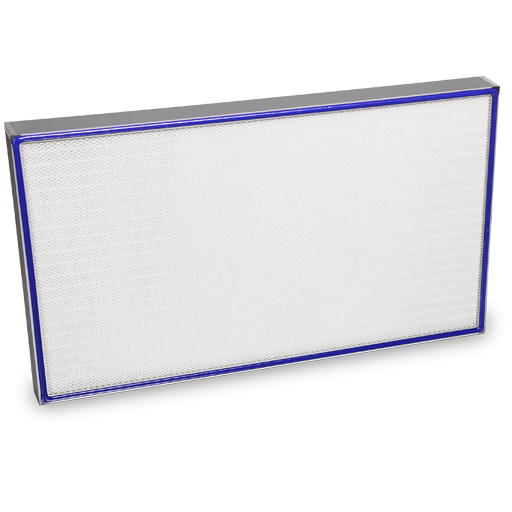
The pharmaceutical industry works with GMP cleanroom classes A (highest purity, e.g. aseptic filling), B (background environment for class A), C, and D. Annex 1 of the EU GMP Guide requires HEPA-filtered supply air for classes A and B, along with regular integrity testing of the installed filters. HS-Luftfilterbau offers HS-Mikro SF-AL cleanroom filters designed with gel seals or foamed gaskets, as well as sealing-seat test groove gaskets for leak-free integrity testing in the installed condition.
DIN 1946-4 and VDI 2083
In Germany, DIN 1946-4 applies to ventilation and air-conditioning technology in hospitals and defines requirements for filter classes, air change rates, and airflow concepts in operating rooms. VDI 2083 complements this as a cleanroom technology guideline and provides planning principles for all industries – from pharmaceutical manufacturing to microelectronics.
HEPA and ULPA Filters from HS-Luftfilterbau
The high-efficiency particulate filter range from HS-Luftfilterbau covers classes E10 to U17 according to EN 1822 and includes different designs for a wide variety of installation situations and requirement profiles:
HS-Mikro SF-AL – Cleanroom Filter with Aluminum Frame
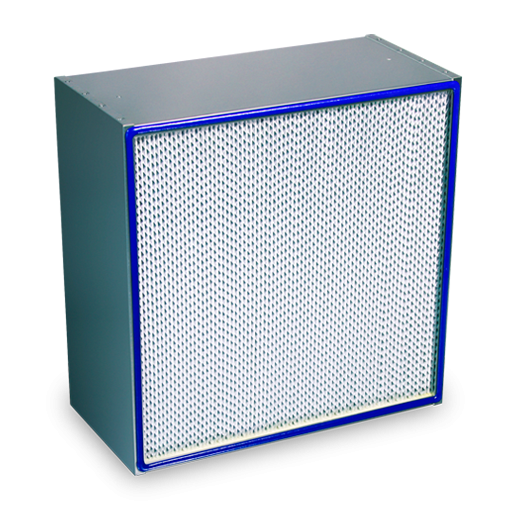
The HS-Mikro SF-AL is our cleanroom filter for the highest demands: a MiniPleat filter pack with thermoplastic separators in an anodized extruded aluminum frame, available in classes E11 to U17. The optimized pleat geometry ensures laminar downstream airflow without additional laminarizing aids. Foamed closed-cell gaskets and gel seals are available as sealing options. For applications in microelectronics and semiconductor manufacturing, the HS-Mikro SF-AL is optionally available in a version with specifically minimized long-term SVOC outgassing – a new level of performance for environments in which even the smallest molecular contamination on wafer surfaces can impair the manufacturing process.
HS-Mikro SF / HS-Mikro RF – Universal High-Efficiency Particulate Filters
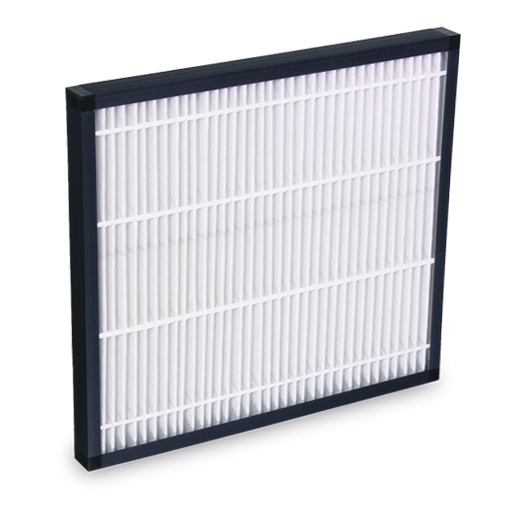
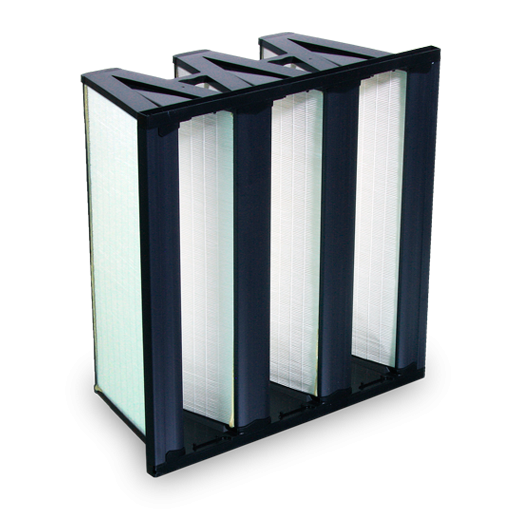
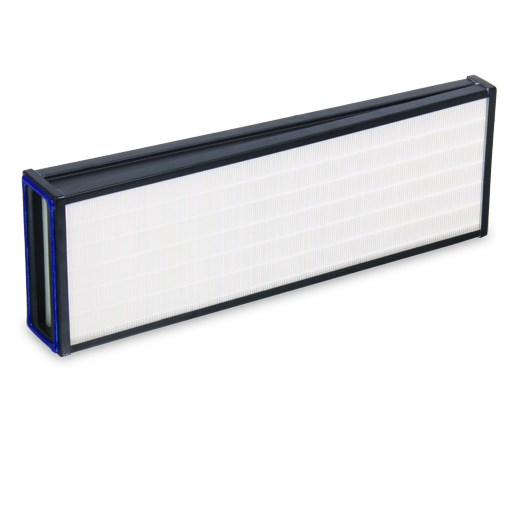
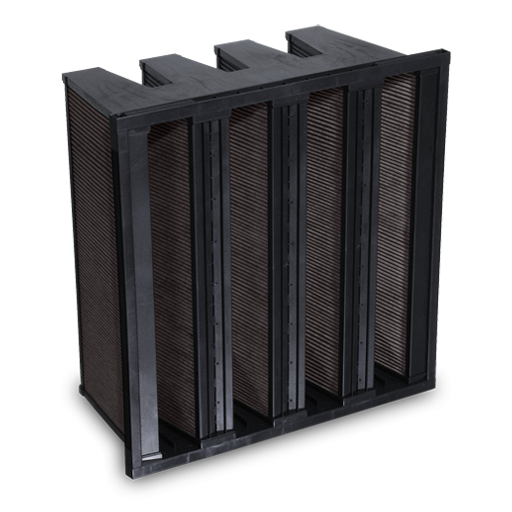
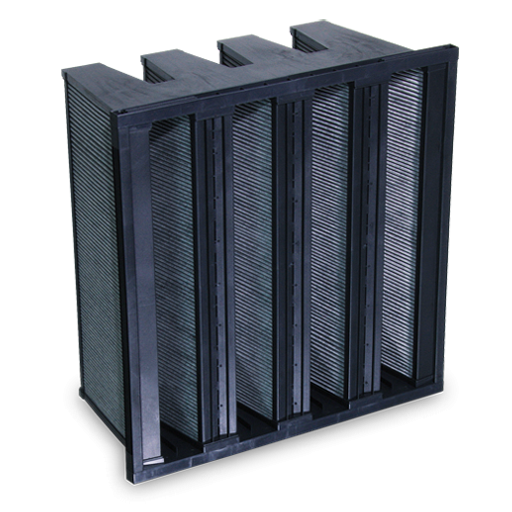
The HS-Mikro SF (HEPA, class H13/H14) and HS-Mikro RF (EPA, class E11) with MDF frames are versatile solutions for process protection in industry and technology as well as for sterile and cleanroom environments. Virtually metal-free and fully incinerable, they are available in depths from 78 to 292 mm. In V-shaped versions (HS-Mikro SFV / RFV), they provide a larger filter area for maximum air volumes with minimal pressure drop.
HS-Mikro S / HS-Mikro R – Separator-Type High-Efficiency Particulate Filters
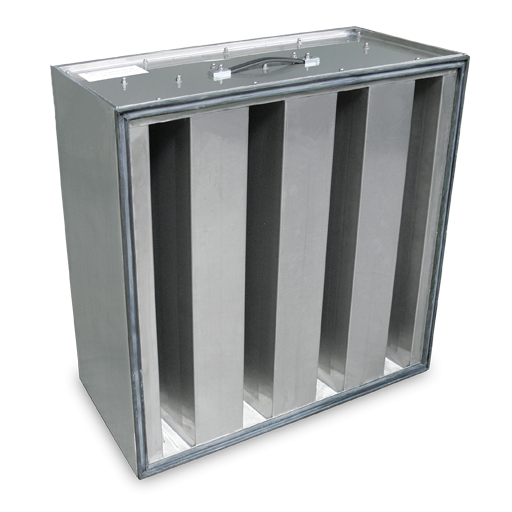
High-performance filters with classic aluminum separator technology for applications requiring high temperature resistance (up to 120 °C or 250 °C) or exceptional mechanical robustness – for example in nuclear exhaust air filtration according to KTA 1401 or in industrial hot gas processes.
Membrane HEPA and ULPA Filters
In addition to conventional glass fiber media, HS-Luftfilterbau specializes in the manufacture of membrane high-efficiency particulate filters. PTFE membrane media offer a fundamentally different separation mechanism compared with conventional glass fiber media: filtration takes place primarily on the membrane surface rather than within the depth of the medium. The result is lower pressure drop at the same filtration efficiency, greater mechanical resistance, and a particularly smooth surface that allows easy decontamination.
Typical Applications
- Pharmaceutical production: HEPA-filtered supply air for GMP cleanrooms in classes A to D, aseptic filling, sterilization areas, and packaging lines. Integrity-testable filters with gel seals or groove gaskets for qualification according to EU GMP Annex 1.
- Hospitals and clinics: High-efficiency particulate filters for operating rooms (TAV ceilings), intensive care units, isolation rooms, and hospital pharmacies in accordance with DIN 1946-4. HS ceiling diffusers for turbulent mixing ventilation in patient rooms and laboratory areas.
- BSL-3 and BSL-4 laboratories: HEPA filters in safety housings with bag-in/bag-out replacement technology (safe change) for contamination-free filter replacement. HS-Luftfilterbau has many years of experience in equipping high-containment laboratories.
- Semiconductor and microelectronics manufacturing: ULPA filters up to class U17 for mini-environments and ISO Class 1 cleanrooms. HS-Mikro SF-AL optionally available with minimized SVOC emissions for contamination-critical lithography and wafer processes.
- Nuclear medicine and nuclear technology: High-efficiency particulate filters according to KTA 1401 for supply and exhaust air systems in nuclear medicine departments, hot cells, and nuclear facilities – with complete traceability and documentation.
- Research and analytics: HEPA/ULPA filters for laboratory equipment, safety cabinets, and cleanroom areas in chemical, biological, and physical research.
Housing and Installation Systems
For the installation of high-efficiency particulate filters in cleanroom, laboratory, and hospital environments, HS-Luftfilterbau offers various housing and installation solutions:
HS ceiling diffuser: Installation housing for introducing particle-free or germ-free air as turbulent mixing ventilation or laminar displacement airflow, specifically for laboratory, hospital, and cleanroom technology. The continuously sealed suspended ceiling interface is adapted to the ceiling type provided on site. The housing is highly leak-tight, corrosion-resistant, and easy to decontaminate.
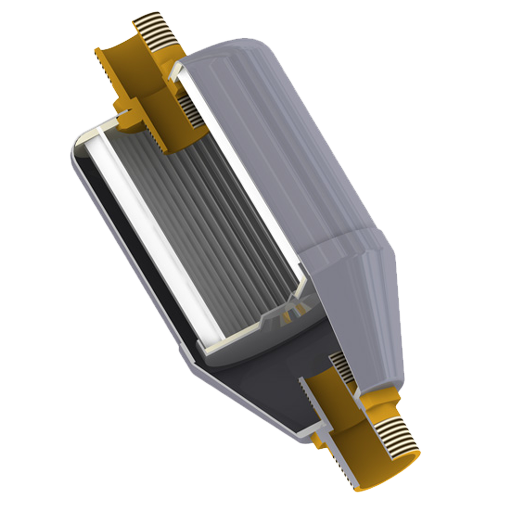
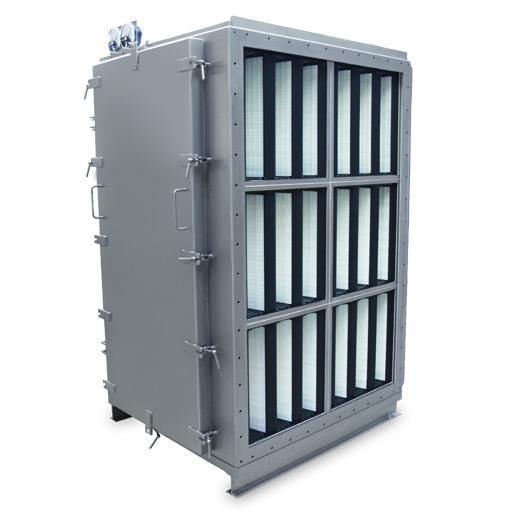
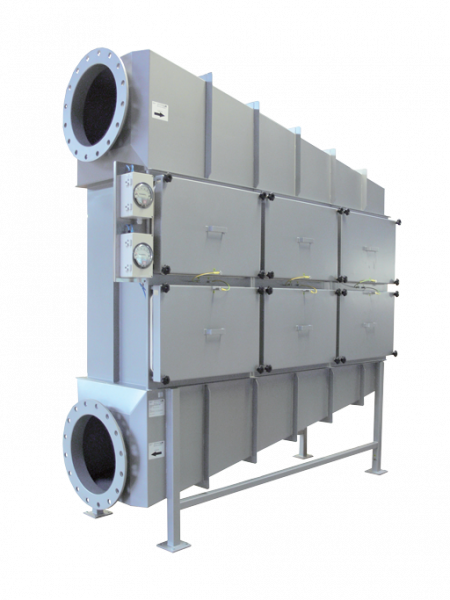
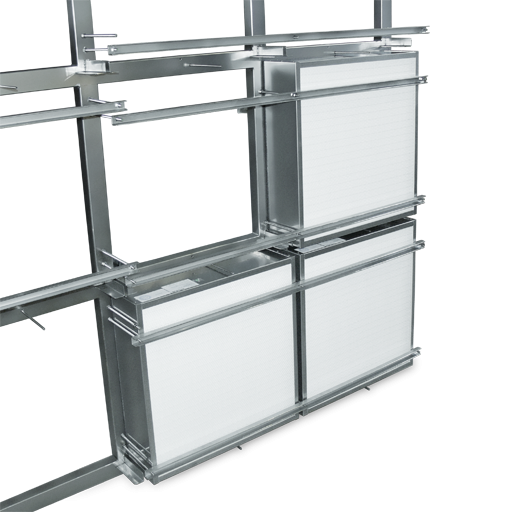
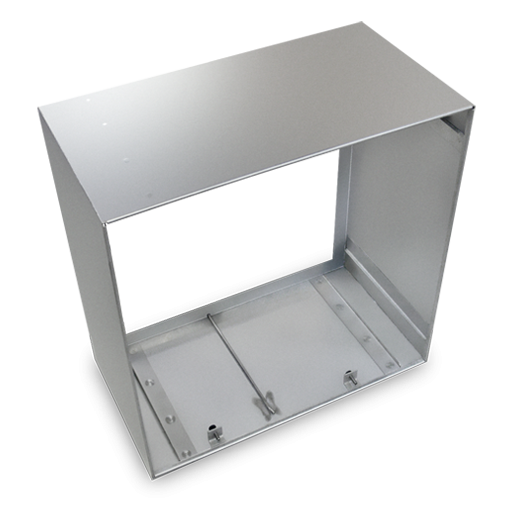
HS particulate filter housings and filter walls: Airtight welded mounting frames made of aluminum profiles for installation in duct systems, machines, and cleanroom walls. Spindle presses ensure the exact sealing fit of the filter elements.
Safety housings with safe-change technology: For BSL laboratories, nuclear facilities, and other safety-critical areas, HS-Luftfilterbau manufactures housings with bag-in/bag-out replacement technology that allow contamination-free filter replacement while maintaining containment.
Quality Assurance and Testing Capabilities
The quality of a high-efficiency particulate filter depends entirely on proper testing. At its Kiel site, HS-Luftfilterbau operates two fully automated HEPA scanners for full-surface scanning in accordance with EN 1822. Every filter from class H13 upward is individually tested and supplied with an individual test certificate (scan report indicating both local and global penetration values). In addition to the standard DEHS test aerosol, PSL aerosol is available for oil-free testing, as required in particular by the semiconductor industry.
Beyond individual testing, HS-Luftfilterbau continuously monitors the materials used – filter media, adhesives, potting compounds, and seals – with regard to VOC and SVOC outgassing. This consistent material control is the prerequisite for ensuring that our filters introduce no unwanted molecular contamination even in the cleanest environments. Our production and testing facilities enable us to meet nearly any customer-specific requirement for filter class, size, frame material, seal type, and outgassing behavior.
Your Advantages with HS-Luftfilterbau
- Two fully automated HEPA/ULPA scanners: Individual testing of every particulate filter from H13 upward with a scan report – optionally using DEHS or PSL test aerosol for the most stringent requirements of the semiconductor industry.
- Filter classes E10 to U17: Complete particulate filter range in MiniPleat and separator designs, complemented by membrane HEPA and ULPA filters with PTFE media.
- Controlled outgassing: Continuous monitoring of materials for VOC and SVOC. HS-Mikro SF-AL optionally available with specifically minimized long-term SVOC emissions for microelectronics manufacturing.
- Safe-change and safety housings: Bag-in/bag-out replacement technology for BSL laboratories, nuclear facilities, and other safety-critical areas – including seal seating tests and complete documentation.
- More than 50 years of experience in critical applications: From ISO Class 1 cleanrooms and operating rooms to BSL-4 laboratories and nuclear facilities (KTA 1401) – HS-Luftfilterbau delivers where compromise is not an option.
Do you need high-efficiency particulate filters for your cleanroom, clinic, or pharmaceutical production? Our engineers will advise you on selecting the right filter class, design, and sealing option – tailored to your specific standards requirements and process conditions. Contact us for individual consultation and a project-specific quotation.