ePM1 55 %, 60 % or 65 %? When the Difference Matters in Practice
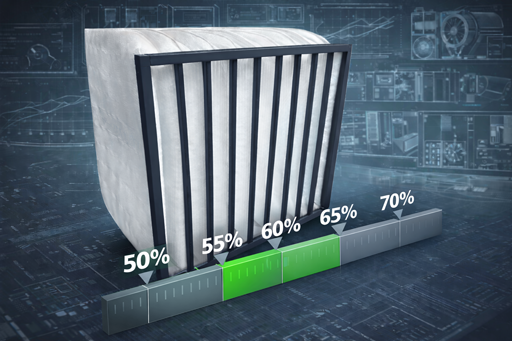
Since ISO 16890 replaced EN 779 in 2018, operators classify air filters by ePM1, ePM2.5 and ePM10. The finer classification brings precision and raises new questions in practice.
From 9 to Over 40 Filter Classes
EN 779 knew nine classes: G1 to G4 for coarse dust and F5 to F9 for fine dust. By combining ePM1, ePM2.5 and ePM10 with efficiency steps of 5 % (50, 55, 60, 65, 70 % and so on), ISO 16890 theoretically allows more than 40 classifications.
Where an F7 filter used to be ordered, the question now is whether ePM1 60 % is sufficient when a competitor offers ePM1 65 %.
Measurement Uncertainty of the Test Method
The test method according to ISO 16890 scatters by several percentage points in repeat measurements. A filter measured at 62 % ePM1 today can reach 59 % or 65 % in the next test. Batch-dependent tolerances of the filter medium add to this. The 5 % grading (55, 60, 65 %) is a convention of the standard.
A filter of class ePM1 60 % and a filter of class ePM1 65 % can therefore consist of the same filter medium and merely have been tested at different times.
Practice: What the Difference Means in Operation
In standard ventilation systems with Central European outdoor air (PM1 concentration of 5 to 20 µg/m³), ePM1 55, 60 and 65 % have little effect:
- Service life: The difference amounts to a few days over several months of operation.
- Energy consumption: It stays the same with comparable pressure drop and dust holding capacity.
- Indoor air quality: There is no measurable difference.
Filters Become More Efficient in Operation
Dust accumulation raises the separation performance during operation. After a few weeks, a filter with ePM1 60 % sits clearly above its initial value. The initial efficiency reflects the state at installation and does not show the operating reality.
When the Efficiency Difference Matters
In these cases the efficiency step deserves a closer look:
- Clean room pre-filtration: More ePM1 efficiency extends the service life of the downstream HEPA stage.
- Highly polluted sites: Industrial areas or urban hotspots with PM1 above 40 µg/m³.
- Special protection requirements: Sensitive production processes or vulnerable groups of people.
For these applications we carry out a detailed design calculation.
What Matters in Filter Selection
In normal HVAC systems, these factors weigh more than 5 percentage points of efficiency:
- Pressure drop characteristic: It determines energy consumption over the service life.
- Dust holding capacity: It determines the service life.
- Mechanical stability: It prevents media rupture and bypass.
- Economic efficiency: It combines purchase, energy and replacement interval into total cost.
Our Recommendation: Check the Figures
When someone argues that 65 % is better than 60 %, three questions help:
- Which concrete performance improvement results in your application?
- Is an economic efficiency calculation available?
- Which measurement uncertainty belongs to the stated value?
In most cases, the effort of the discussion about 5 percentage points is out of proportion to the practical benefit.
Result for Practice
ISO 16890 considers particle sizes more precisely than EN 779. The large number of classes must not create false precision. For former F7 applications in normal building ventilation, ePM1 55, 60 and 65 % are functionally largely equivalent. What counts is the design of the entire filter system.
You will find suitable types under Bag Filters and Compact Filters. The information is also available as a download: Download this information.
